
Wirral voted 56-0 against the CO2 pipeline. Its own report says refusing survey access changes little: notice was served on the Wallasey foreshore in August.
Wirral Council is being asked tonight to let surveyors onto its own land for a carbon dioxide pipeline it voted unanimously to oppose six months ago. The report going to the Policy and Resources Committee is blunt about why. Refusing would not stop the surveys.
The committee meets at 6pm on Wednesday 9 September at Wallasey Town Hall, and the meeting is webcast.
Peak Cluster wants to capture CO2 at four cement and lime factories in Derbyshire and Staffordshire, then pipe it to permanent storage under the Irish Sea. The route crosses the Wirral peninsula. The council’s report says the scheme has implications for six wards:
- Wallasey
- Pensby and Thingwall
- Hoylake and Meols
- Greasby, Frankby and Irby
- Moreton West and Saughall Massie
- Leasowe and Moreton East
The council already voted against it, 56 to nil
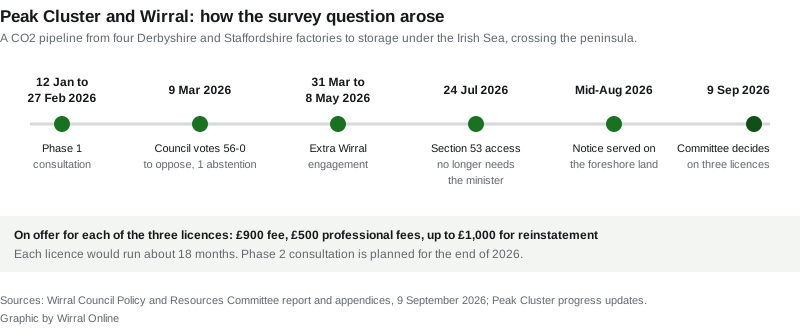
Six councillors requisitioned an extraordinary meeting of the full Council on 9 March 2026. Laura Beveridge, chair of Action Against CCS, was allowed to address the chamber. A Labour motion, amended by the Conservative group and accepted as friendly, was then carried 56 votes to nil with one abstention.
The minute of that meeting is published in full as an appendix to tonight’s report. Councillors resolved to:
- request that the Government cancel the Peak Cluster project outright
- formally oppose routing the pipeline through Wirral and object to the regulators
- call for an independently verified environmental and safety impact assessment
- demand emergency-response planning and long-term monitoring if it goes ahead
- ask all 66 councillors to sign a letter to the Secretary of State, copied to Wirral’s four MPs
The motion described the peninsula as being used “as a dumping corridor for industries over 200 km away”. It also said, in terms, “we are not climate deniers”.
What changed in July
Officers set out why the vote and tonight’s decision are separate questions.
Wirral is not the promoter of the scheme and does not decide it. Peak Cluster is a Nationally Significant Infrastructure Project. It needs a Development Consent Order from the Secretary of State, examined by the Planning Inspectorate, not by the council.
Two sets of powers let the promoter onto land regardless. Section 172 of the Housing and Planning Act 2016 allows entry to survey or value land, with a magistrates’ warrant needed only to use force. Section 53 of the Planning Act 2008 covers survey access for a DCO.
The section 53 route is the one that has moved. Until 24 July 2026 it could only be used with the Secretary of State’s authorisation. Since then, an applicant can serve notice directly. The report says Peak Cluster served the council notice on some of its land in mid-August, specifically the foreshore, to allow seasonal surveys that are time critical.
That land is therefore off the table tonight. The report states there is no decision to take relating to it.
Officers also warn that if the council obstructed access after a section 53 notice, Peak Cluster could apply for a warrant, and a magistrates’ court could order the council to pay its costs.
What is actually being decided
Three tranches of council land are covered by the licence request, listed in Appendix 1:
Tranche one
- land south of Saughall Massie Road, Greasby
- land on the east side of Heron Road, Meols
- land fronting Heron Road and Saughall Massie Road, Saughall Massie
- land known as the Buldower, north of Birkenhead Road, Meols
- the foreshore at Wallasey
Tranche two
- land at Acres Road, Meols, and on the south side of Acres Road
Tranche three
- the Buldower and land north of Birkenhead Road, Meols
The surveys split into two kinds. Non-intrusive work covers noise and vibration, heritage, landscape and visual, water, traffic and arboriculture, plus biodiversity surveys for newts and amphibians, birds, bats, otter and water vole and badger. Some of that can happen out of hours and only at certain times of year. Intrusive work would mean boreholes, trial pits, soakaway tests, utility identification and resistivity surveys.
The money is small. Peak Cluster is offering £900 per licence, £500 in professional fees, and up to £1,000 per licence towards reinstatement if the ground is damaged. Three licences are sought, each running about 18 months, extendable by a further year for more fees.
Officers describe the benefits to the council, such as sharing survey results, as “quite limited”. The report’s environment section is similarly plain: the scheme would cut CO2 from those four factories, but “there will also be detrimental effects associated with delivery of the scheme”.
What it means for you
Nothing is being approved tonight beyond survey access. No pipeline route is being fixed and no planning permission is being granted. That decision sits with the Secretary of State.
If you live near any of the land listed above, the practical effect of a licence is surveyors, and possibly drilling rigs, appearing on council land over roughly the next 18 months. Some biodiversity surveys run at dusk or at night by their nature.
The point at which residents get a formal say is the promoter’s phase 2 consultation. Peak Cluster ran its phase 1 consultation from 12 January to 27 February 2026, and additional Wirral engagement from 31 March to 8 May 2026, including sessions at the Floral Pavilion. It says phase 2 will launch “towards the end of the year” with more detailed designs. After that comes the DCO application itself, when the Planning Inspectorate takes written representations from anyone who registers.
Peak Cluster says the scheme, with the linked Morecambe Net Zero project, would attract £5 billion of investment and keep more than 3 million tonnes of CO2 a year out of the atmosphere, from factories making 40% of Britain’s cement and lime.
We will report what the committee decides. For other council decisions affecting the peninsula, see our Wirral planning news page.
Sources
- Wirral Council, Policy and Resources Committee agenda, 9 September 2026
- Wirral Council, Peak Cluster: licence agreement to access council land (report of the Assistant Director Property and Investment)
- Wirral Council, Appendix 1: summary of subject land and licence
- Wirral Council, Appendix 2: minute extract, Extraordinary Council, 9 March 2026
- Peak Cluster, progress updates and project overview
Have your say