
Wirral's three-weekly bin consultation is open to 25 November. The alternative, a smaller 180-litre bin, would cost £3.75m, and the council expects resistance.
Wirral Council wants to empty green bins every three weeks instead of every two, and it will start asking residents what they think on Wednesday 14 October. The council’s chief executive, Matthew Bennett, approved a six-week public consultation on Thursday 8 October (officer decision notice, Wirral Council, 8 October 2026). No councillor called the decision in before the 13 October deadline, so it took effect on 14 October.
Updated 18 October: the questionnaire is now live, and the council has published its options appraisal. It names the smaller bin (180 litres), costs replacing every bin at £3.75m, and scores three-weekly collections lowest of the three options for customer acceptability. Details below.
Updated 14 October: the council’s own announcement gives the consultation dates as 14 October to 25 November, a day later than the committee report’s timetable, and adds new detail on who is affected, the saving and support for larger households. Details below.
The council says the change would affect about 142,000 households that have a green wheelie bin. Homes that use sacks or communal bulk bins would not be affected. The council puts the saving at around £1.2m a year in collection costs (Wirral View, 8 October 2026).
No change has been decided. The report behind the decision says approval “is sought only to undertake consultation and engagement activities”. But it is also plain about where the council stands: three-weekly collections of non-recyclable waste are described as “the Council’s preferred option”, and the consultation will tell residents which other options were “considered by the Council but discounted” (consultation report, Wirral Council).
The green bin is the one for everything that cannot be recycled: nappies, crisp packets, plastic film, polystyrene, pet litter. It is currently collected every other week (green bin, Wirral Council). The grey recycling bin, the weekly food caddy and the paid-for brown garden bin are not part of this proposal. Our bin collection days page has the current schedule for all four.
The dates
The report’s timetable runs like this:
| Date | What happens |
|---|---|
| Wednesday 14 October 2026 | Consultation opens online, for six weeks |
| Wednesday 25 November 2026 | Consultation closes |
| 25 November to 3 December 2026 | Responses analysed, report written |
| Wednesday 3 February 2027 | Report to the Environment, Climate Emergency and Transport Committee |
The dates above follow the council’s announcement of 8 October, which says residents can take part online “between 14 October and 25 November”. The committee report had given 13 October to 24 November in its timetable, and 22 November in its text. The questionnaire is at haveyoursay.wirral.gov.uk/future-waste. It was open when we checked on 18 October, with the council’s options appraisal under Documents.
Why now: the £348.6m Biffa contract
The timing follows directly from the council’s new waste contract.
- Biffa has collected Wirral’s bins since 2006. The current contract ends in August 2027.
- On 22 July 2026 the Policy and Resources Committee awarded Biffa a new eight-year contract, with an option for a further eight, from 27 August 2027. The maximum value is £348.6m over the full 16 years (Policy and Resources Committee, 22 July 2026).
- The tender asked Biffa to price two ways of running the service. Option A keeps fortnightly collections of non-recyclable waste, but with a smaller bin. Option B moves to three-weekly collections.
- The two prices were kept separate so the council could decide later “on affordability, service impacts and overall value for money” (contract award report, 15 June 2026).
So the choice the council is now consulting on is not “three-weekly or carry on as now”. On the council’s own account, the two options it priced were a smaller green bin or a less frequent one. The June report puts the new contract at about £21.8m a year, plus around £2.35m a year in borrowing costs for vehicles and the Dock Road South depot, against a current budget of £20.5m.
When councillors approved the contract in June, the minutes record members raising “concerns around a lack of modelling for proposed collection options, contamination levels and behavioural challenges” (minutes, 15 June 2026). The October report says the consultation will give residents “a summary of the options appraisal that has led to the preferred option”.
How Wirral’s recycling compares
The council’s case rests on “reducing residual waste and increasing recycling performance”. The latest national figures show how far Wirral has to go.
In 2023/24, Wirral sent 32.4% of its household waste for reuse, recycling or composting. The provisional figure for England was 42.3%. Each Wirral household put out 532.2kg of non-recycled waste over the year (local authority collected waste statistics 2023/24, Defra).
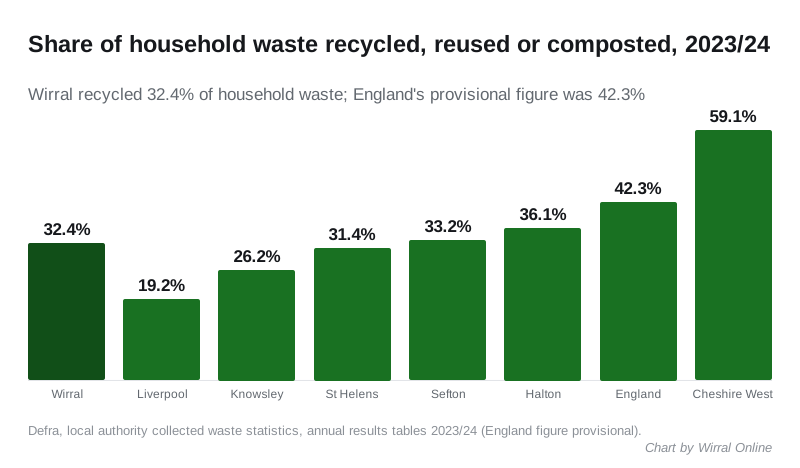
The same tables put Wirral’s neighbours at:
- Liverpool 19.2%
- Knowsley 26.2%
- St Helens 31.4%
- Sefton 33.2%
- Halton 36.1%
- Cheshire West and Chester, across the M53 at Ellesmere Port, 59.1%
Wirral’s rate has barely moved in a decade. The same Defra series shows 36.0% in 2014/15, 33.3% in 2019/20 and 31.2% in 2022/23. The weekly food waste collection, which finished rolling out across the borough in August, should lift the 2026/27 figure whatever happens to the green bin. Food waste was previously going into it.
What the consultation will and will not do
The report sets out the method the chief executive approved:
- an online questionnaire, with paper copies available
- “stakeholder engagement activities” and feedback through “a range of accessible channels”
- a workshop for council staff run by the Consultation Institute, which has advised on the approach
- briefings for ward councillors throughout
Residents will be asked for their views on the preferred option, and will “have the facility to suggest other ways” to cut non-recyclable waste and raise recycling. The council’s Finance Working Group endorsed the plan on 8 September.
The legal section of the report is worth reading, because it tells you what the council has to do with your answer. It cites the Gunning principles: consultation must happen while proposals are “still at a formative stage”, give enough information “to permit intelligent consideration and response”, allow adequate time, and ensure responses “are conscientiously taken into account before the decision is made”. It also relies on a 2014 Supreme Court case, Moseley, as authority that a council may name a preferred option and need not consult on every alternative, but may have to tell people “at least in outline, about realistic alternatives and why the authority is proposing not to pursue them”.
The report lists three risks: too little evidence if it did not consult, low participation, and “misunderstanding regarding the purpose of the consultation”. On the last, it says communications “will emphasise that no decision has yet been made”.
The report itself did not say how assisted collections would work, or what would happen for large families or households with nappies or medical waste. The council’s announcement now answers some of that (Wirral View, 8 October 2026):
- Assisted collections would continue, including new requests.
- A larger green bin could still be requested by households that recycle fully but have medical waste, more than six people, or two or more children in disposable nappies.
- The change would be phased in across Wirral, with residents told “well in advance” of their new collection day.
- The grey recycling bin, the weekly food caddy and the brown garden bin would not change.
The council also explains why it prefers three-weekly collections to a smaller bin. Replacing every household’s green bin “would involve significant costs and service disruption”, it says.
What the options paper says
The council’s options appraisal, dated 8 October, is now published with the questionnaire (Options Appraisal: Future Waste Collection, Wirral Council). It compares three options:
- Option 1, no change: fortnightly collections from the current 240-litre green bin
- Option 2, a smaller bin: fortnightly collections, with every 240-litre bin replaced by a 180-litre one
- Option 3, three-weekly: the same 240-litre bin, emptied every three weeks
The smaller bin is the one the council has ruled out on cost. The paper estimates £3.75m in capital spending to replace the bins. For three-weekly collections, it estimates a possible £1.2m cut in collection costs and £0.85m in disposal costs. It does not say whether those are yearly figures.
The council scored each option out of 5 against six weighted tests:
| Test | Weight | No change | 180-litre bin | Three-weekly |
|---|---|---|---|---|
| Environmental impact | 30% | 1 | 4 | 5 |
| Recycling performance | 25% | 1 | 4 | 5 |
| Financial impact | 20% | 3 | 2 | 5 |
| Deliverability | 10% | 5 | 3 | 4 |
| Customer acceptability | 10% | 5 | 3 | 2 |
| Operational risk | 5% | 5 | 3 | 3 |
| Weighted score | 230 | 335 | 445 |
Three-weekly collections score highest on environmental impact, recycling and cost. They score lowest of the three on customer acceptability, and joint lowest on operational risk. The paper lists the downsides it expects:
- “Greater behavioural change required from residents”
- more customer contacts and complaints while the change beds in
- “enhanced support arrangements for larger families and households with specific needs”
- “Higher reputational risk during transition period”
It also rates the risk of fly-tipping and side waste (“illegal disposal / side waste”) as medium, against low if nothing changes. Customer acceptability carries only 10% of the weighting, while environmental impact and recycling performance together carry 55%. The paper concludes that resistance “can be mitigated through effective communication, phased introduction, and support arrangements”.
What it means for you
- From 14 October to 25 November, you can tell the council what you think at haveyoursay.wirral.gov.uk/future-waste. Paper copies are available for those who need them.
- Nothing changes to your collections now. Green bins stay fortnightly at least until the new contract starts on 27 August 2027, and any change needs a councillors’ decision first.
- The decision is pencilled in for 3 February 2027, at the Environment, Climate Emergency and Transport Committee. Meetings are at Wallasey Town Hall and webcast.
- Read the options paper before you answer. It is short, four pages, and it shows how the council weighed your views against cost and recycling rates.
- If you need a bigger bin or an assisted collection, those arrangements would carry on. Say so in your response if they matter to your household.
- Check what already goes in the grey bin and the food caddy. The more that comes out of the green bin, the less a three-weekly collection would bite. Our bin collection days page lists what each bin takes.
Correction, 14 October 2026: this article first gave the consultation dates as 13 October to 24 November, from the committee report’s timetable, and said the consultation covered all 153,000 households in the borough. The council’s announcement gives 14 October to 25 November, and about 142,000 households with a green wheelie bin. We have corrected both.
Have your say