
Wirral has been given £3m, the most any council gets, to bring derelict buildings back into use. Residents should be asked which ones before the end of 2026.
Wirral is to receive £3 million from the government’s new Derelict Buildings Fund. That is the largest amount any council can get. The money is for bringing long-empty or derelict buildings back into use, and the council has not yet chosen any.
The Ministry of Housing, Communities and Local Government published the allocations on Wednesday 28 October. Wirral is one of 60 councils on the list, and one of 11 to receive the £3 million maximum (MHCLG, Derelict Buildings Fund interim guidance).
The government first announced the £125 million fund on 25 September, as part of a £210 million package for high streets (GOV.UK, 25 September 2026).
Why Wirral got the maximum
The government chose the 60 council areas with the highest employment deprivation, using the Indices of Deprivation. It then shared £120 million between them by population, with a floor of £1 million and a cap of £3 million. The other £5 million is kept back for specialist support to councils (MHCLG, methodology note).
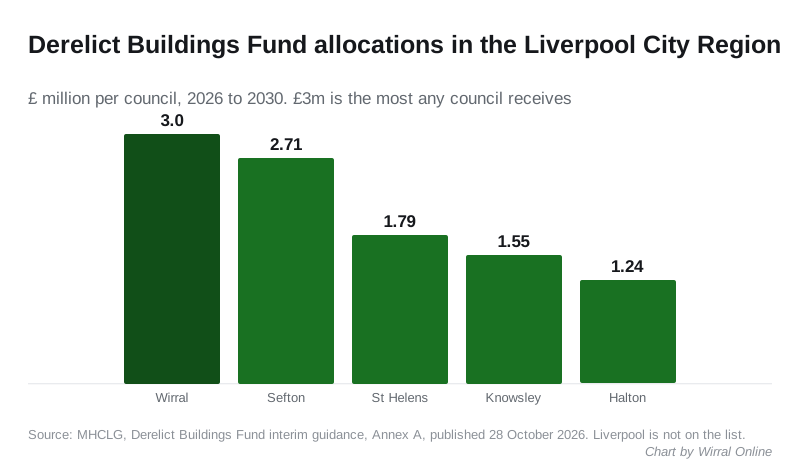
Wirral’s population put it at the cap. Four other Liverpool City Region councils are also on the list, with smaller sums. Liverpool itself is not.
| Council | Allocation |
|---|---|
| Wirral | £3.00m |
| Sefton | £2.71m |
| St Helens | £1.79m |
| Knowsley | £1.55m |
| Halton | £1.24m |
What the money can be spent on
The guidance says the fund is for “prominent long term vacant or derelict buildings”. It can pay to buy, restore and reuse them. Examples it gives include:
- empty shops and offices
- department stores
- pubs, theatres and cinemas
- former places of worship and other heritage buildings
Buildings on high streets and in town or district centres come first. A building elsewhere can qualify if its reuse would clearly benefit the community, for example a gateway building on a busy main road.
The new use can be community, cultural, commercial, public service or a mix. The council does not have to own the building, and can back community or co-operative ownership. Wirral could spend the £3 million on several buildings or on one large project.
When it happens
The fund runs from 2026 to 2030. The guidance sets out this timetable:
| When | What happens |
|---|---|
| By the end of 2026 | The council should start asking residents and begin a longlist of buildings |
| By April 2027 | First progress report to the government, covering the buildings chosen and the consultation |
| April to June 2027 | First delivery payment, if the report shows progress and community engagement |
| Autumn 2027 | Update on how the projects are going |
The council does not need government approval for its project plans before it spends the money. It reports every six months instead.
What it means for you
- You should get a say on which buildings. The guidance tells councils to involve residents “before key choices about projects and potential uses have been made”. It names buildings that “the community feel bring down the area”, attract vandalism or anti-social behaviour, or hold back other development.
- Wirral’s MPs are part of it. Local MPs will be “Programme Champions” and may endorse specific projects.
- Nothing has been chosen yet. Wirral Council has not published a list of buildings or announced how it will run the consultation. We will report it when it does.
- Groups can get involved. The guidance lists residents, community and faith groups, local businesses, heritage and sports organisations, and property owners among those the council should talk to.
The council’s existing regeneration work is covered on our Wirral planning news page.
Have your say