
Wirral's hospital trust is the first in the North West to use a more personalised pre-eclampsia risk test as routine pregnancy care. Checked November 2026.
Expectant parents in Wirral are now being offered a more personalised test for pre-eclampsia risk as routine care in early pregnancy. Wirral University Teaching Hospital (WUTH) says it is the first NHS trust in the North West to bring in the enhanced screening. The aim is to find those most at risk earlier, so that preventative treatment can be offered.
Pre-eclampsia is a serious high blood pressure condition in pregnancy. WUTH says high blood pressure disorders, including pre-eclampsia, affect around one in 10 people in their first pregnancy. They are also a leading cause of premature birth and pregnancy complications.
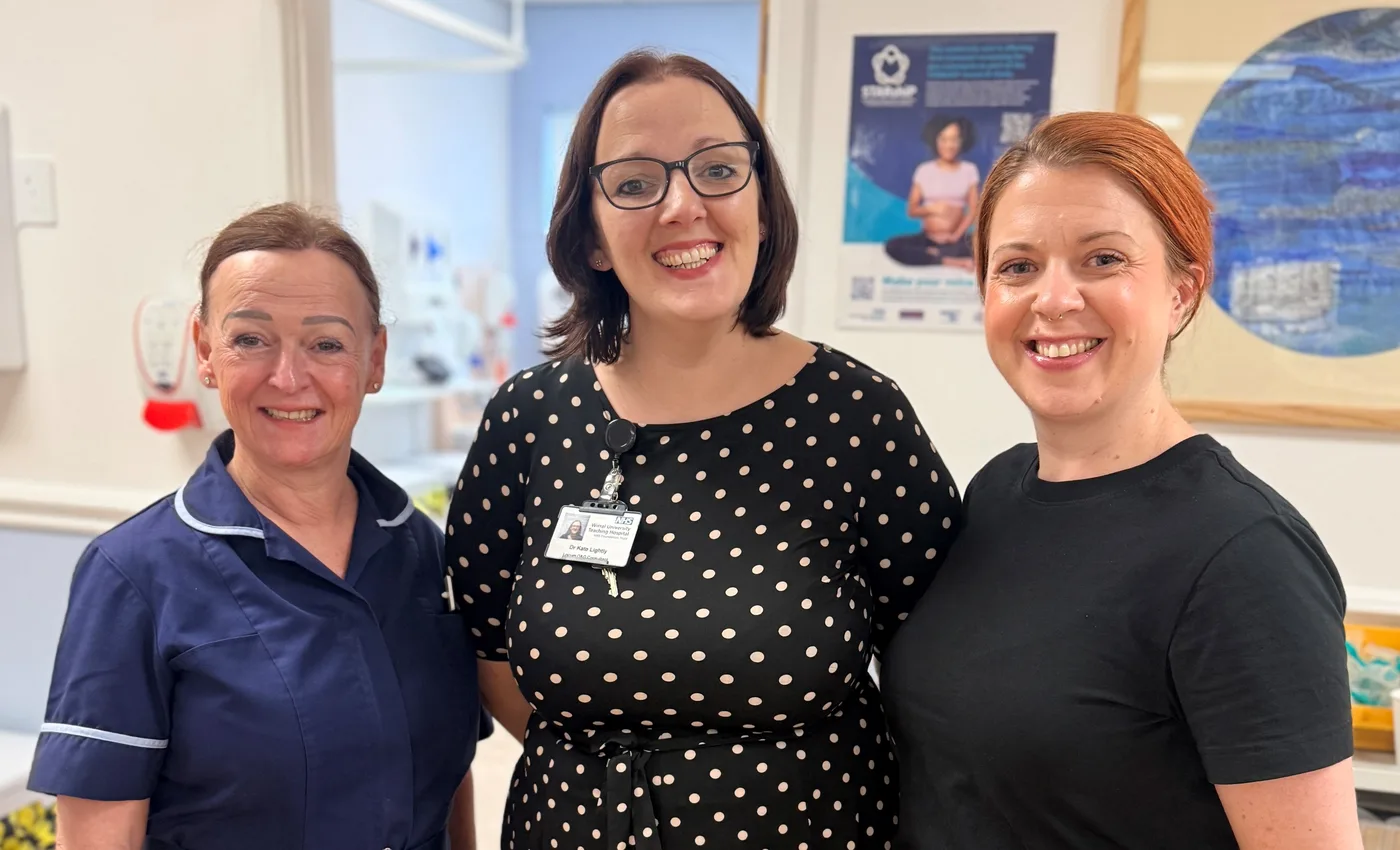
Dr Kate Lightly, Consultant Obstetrician and Gynaecologist and Research Lead for Women’s and Children’s Services at WUTH, said:
“Pre-eclampsia poses serious risks for parents and babies, so early identification of those who are more likely to develop pre-eclampsia is incredibly important.
“This new screening pathway gives us a much more accurate way of assessing risk during early pregnancy and allows us to offer preventative treatment to those most likely to benefit from it.”
How the new test differs
The change comes through STARshiP (Screen and Treat with Aspirin to Reduce Pre-eclampsia), a national research study. It compares the test the NHS uses now, set out by the National Institute for Health and Care Excellence (NICE), with one from the Fetal Medicine Foundation (FMF).
| NICE test | FMF test | |
|---|---|---|
| What it uses | Details of your current and previous pregnancies, family members’ previous pregnancies and health conditions | Pregnancy information plus extra measurements of how the placenta is working |
| What it gives | The risk assessment currently used in the UK | A risk assessment personalised to the current pregnancy |
WUTH says the FMF approach has been shown to identify those at higher risk more accurately than current methods. The study is testing a further question: whether using it reduces premature births. That answer is not in yet.
According to the study, aspirin can be recommended to help prevent pre-eclampsia from developing. It says aspirin is safe in pregnancy and should be started by the 16th week for those at risk.
Why Wirral went first
WUTH was the first NHS trust in the UK to start the STARshiP study, and it was selected as the first to switch to the new test as routine screening. The order was not a ranking. A computer program set the timing of each trust’s switch at random at the start of the study.
The study covers 16 NHS trusts in England, and all their hospitals will move to the FMF test over its course. It will use the data of more than 235,000 pregnant women and people and their babies, which the study team calls one of the largest pregnancy screening studies ever run in England.
Janelle Holmes, Chief Executive of WUTH, said:
“We are delighted to be the first organisation in the Northwest to offer this enhanced screening as part of routine maternity care. It means that expectant parents in Wirral can benefit from the very latest advances in care, helping us to identify those at higher risk of pre-eclampsia earlier and provide the support they need.
“Being actively involved in research means we can bring promising new approaches to local services sooner, ensuring that our communities benefit from the latest developments in maternity care.
“This is a fantastic example of how research can directly benefit local families. Earlier identification of risk allows us to offer the right support at the right time, helping to improve outcomes and give every baby and family the best possible start.”
What it means for you
If you are pregnant and under WUTH’s care, the screening is part of your usual care. These points come from the study’s Wirral page:
- You can say no. You can choose whether to have screening, and that choice does not affect your care. You cannot ask for the other test instead.
- You do not sign up. No written consent is needed, because the study uses information the NHS already collects about your pregnancy and your baby’s health.
- You can keep your data out. Use the STARshiP opt-out form, which asks for your NHS number and date of birth, or the national data opt-out. The study’s deadline is 1 August 2029, and your care is not affected.
- Ask your midwife or doctor. They are the people to talk to if aspirin is recommended to you, or if you need help with the form.
When we checked on 5 November, that Wirral page still described the NICE test as the one in use at the hospital. The trust’s announcement says the switch has been made, so ask your midwife which test you are having if you want to be sure. The trust has not given the date of the switch or how many pregnancies it expects to screen.
The study’s site also has its information in Arabic, Bengali, Polish, Punjabi, Romanian and Urdu. Anyone with experience of pre-eclampsia risk testing can fill in its 10-minute questionnaire.
Who runs the study
The University of Manchester sponsors STARshiP, working with Manchester University NHS Foundation Trust and the University of Nottingham. The Nottingham Clinical Trials Unit manages it. Funding comes from the National Institute for Health Research (project reference NIHR152762), with support from the charity Action on Pre-Eclampsia.
Have your say