
Wirral Council's consultation on closing Millfields Primary in Eastham runs to 7 December: 21 pupils, a £608,299 deficit and special measures. How to respond.
Councillors voted on Wednesday 14 October to open a 12-week consultation on closing Millfields Church of England Primary School in Eastham. The school on Willington Avenue has 21 pupils on roll this term, a cumulative deficit of £608,299, and was placed in special measures by Ofsted in June. The Director of Children, Families and Education recommended that the Children, Young People and Education Committee authorise the consultation (report to committee, 14 October 2026).
Updated 28 October: the consultation is open. It runs from 26 October to 7 December 2026, about six weeks, not the 12 weeks the committee report described. Responses go through the council’s online survey on its Have Your Say page, which also offers a paper copy; email schoolsconsultation@wirral.gov.uk for help or another format. The council will hold in-person sessions at the school for Millfields parents and carers. The full proposal document is on the council website.
Updated 18 October: the committee approved the recommendations on 14 October. Its decision, published on 16 October, authorises the Director of Children, Families and Education to run the Stage 1 consultation on closure, then decide with the committee’s chair and spokespersons whether to publish a formal proposal; if so, the question comes back to the committee. Councillors can call the decision in until 21 October; if they do not, it takes effect on 22 October (decision notice, Wirral Council). The consultation dates and how to respond have not been published yet.
The report is direct about the conclusion the council and the school’s interim board have reached: “consultation on closure represents the most responsible, sustainable and deliverable course of action”. The Diocese of Chester, which shares governance of the voluntary controlled school, “agrees with this view”.
The vote does not close the school. It starts the first of five statutory stages, and the committee would have to take a separate decision later. The meeting at Wallasey Town Hall was webcast (agenda, Children, Young People and Education Committee).
The numbers in the report
The school has a published admission number of 30 a year and room for more than 210 pupils, excluding the nursery. The report says:
- 21 pupils were on roll in September 2026
- three children started in reception this September
- the nursery could not open this year “due to insufficient pupil numbers”
- the school runs three classes: four pupils in reception to Year 2, seven in Years 3 to 5, and ten in Year 6
- pupil projections “indicate a continued decline”
The money follows the pupils, because most school funding is paid per child. The deficit stood at £608,299 on 31 March 2026. The school “is unable to set a balanced budget for 2026/27 or future years”, with an in-year shortfall of £198,472 forecast this year. About £135,000 of capital work is needed on the toilets. The council had been paying for temporary teaching staff up to July 2026 and says that “is not sustainable”.
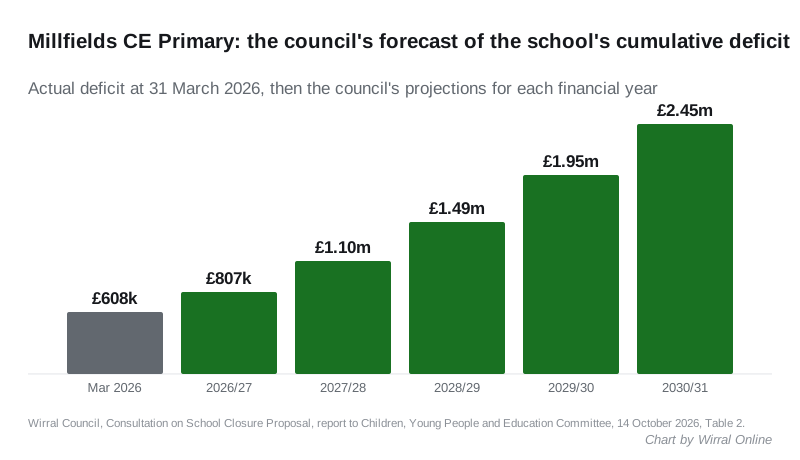
The council’s projection is for the cumulative deficit to reach £2,449,537 by 2030/31. If the school closes, that deficit, plus redundancy and pension costs, falls on the council.
What Ofsted found in June
Ofsted inspected the school on 23 June 2026 and published its report on 6 October. It concludes that the school “requires special measures because it is failing to provide an acceptable standard of education, and the persons responsible for leading, managing or governing the school are not demonstrating the capacity to secure the necessary improvement” (inspection report, Ofsted).
Under Ofsted’s report card system there is no single overall grade. Millfields is rated:
| Area | Grade |
|---|---|
| Safeguarding | Met |
| Personal development and wellbeing | Needs attention |
| Achievement | Urgent improvement |
| Attendance and behaviour | Urgent improvement |
| Curriculum and teaching | Urgent improvement |
| Inclusion | Urgent improvement |
| Leadership and governance | Urgent improvement |
The inspectors’ account is not all one way. They found children in the early years “progress well”, staff who help pupils calm down when they struggle, a “harmonious atmosphere” at break times and a “warm welcome” at the gate each morning. But they also found that “most lessons are disrupted”, that pupils “have many gaps in their knowledge” which “widen” as they move up the school, and that attendance “remains low”.
This was the school’s third poor inspection in a row. It was judged to require improvement in 2021 and again in March 2024. A monitoring visit in September 2025 found that “leaders were not taking effective action”. The council then asked the Department for Education to replace the governing body with an interim executive board, which took over in March 2026. Its chair is Julie Barlow. The substantive headteacher “is no longer in post”, and the school is run by an acting head of school with an executive headteacher from a neighbouring school.
The alternatives the council says it has ruled out
The report lists five options other than closure and the reason each was set aside:
- Recovery as a standalone school: no “credible or deliverable strategy” to lift pupil numbers in a realistic time
- Federation with another school: would need council funding “equivalent to approximately 100 pupils” for three to five years, with no guarantee the roll would recover
- Amalgamation: no “practical or geographically appropriate” partner, partly because of the school’s Church of England status
- Academisation: the finances, falling roll and leadership problems make a sponsor unlikely “without substantial ongoing financial support”
- Managed decline: “prolonged instability” and more staff leaving
What happens next
Closing a maintained school follows a five-stage process set out in the School Organisation Regulations 2013 and the Education and Inspections Act 2006:
- Consultation, now running 26 October to 7 December, with parents, staff, governors, the diocese and the wider community. The director would then decide, with the committee’s chair and party spokespeople, whether to go further.
- Publication of a formal statutory proposal, which opens a four-week period for objections.
- Decision by the committee, within two months of that period closing. The report commits the director to bringing the question back to councillors at this point.
- Referral to the Schools Adjudicator, in some circumstances.
- Implementation: moving pupils, staffing, the site.
The council owns the playing fields, but the land under the school buildings belongs to the Chester Diocesan Board of Education. The report says the two will “work together to achieve the best outcome for a potential vacant asset”.
The equality assessment published alongside the report accepts that closure would mean “transfer to alternative schools”, “changes to peer groups and support networks” and “increased travel times” for the children, and promises transition plans, early allocation of places and reviews of education, health and care plans for pupils with special needs (equality impact assessment).
What it means for you
- If your child is at Millfields: nothing changes yet. The council says the interim board stays in place and the school keeps running while views are gathered. The council will hold in-person sessions for parents and carers at the school. The earliest a closure decision could come is after a further four-week objection period and a second committee vote, so not before early 2027.
- If you are choosing a reception place for September 2027: the national application deadline is 15 January, after the consultation closes but before any final decision. Ask the council’s admissions team directly what the proposal means for a Millfields application before you list it.
- If you live in Eastham or Bromborough: anyone can respond, not only parents. Fill in the online survey by 7 December, or ask for a paper form at schoolsconsultation@wirral.gov.uk.
- The council lists six Wirral primaries within three miles with spare places, including Christ The King Catholic Primary and Mendell Primary, and six schools in Cheshire West and Chester. The nearest Wirral Church of England school is more than three miles away (alternative school places, Wirral Council).
Have your say